Customer Snapshot
- Industry: Generative AI creative software
- Scale: Started in 2024, expanded to millions of creative users globally
- Business Model: Primarily B2C today, with professional creatives driving a bottom-up move into enterprise accounts
- Primary users: Professional creatives, creative teams and brands
- ImageKit use cases: Image and video delivery, real-time transformations, thumbnail generation, optimization and digital asset management
About FLORA
FLORA is a unified creative environment for building with generative AI. Its node-based canvas brings together leading models for image, video, text and audio generation, allowing creators to connect individual generative actions into repeatable workflows. Those workflows can then be turned into focused applications for tasks such as concept development, product visualization, campaign creation and fashion content production.
Rather than adding AI features to a traditional design interface, FLORA is rethinking creative software from first principles. It combines the exploratory freedom of a visual canvas with the repeatability of an automation platform.
Today, millions of creatives, whether individual creators or those at large enterprise clients, use FLORA across brand and marketing, product visualization, film and VFX, and more, compressing weeks of iterative work into hours.
The challenge: Scaling media delivery without slowing the canvas
Images and videos have been central to FLORA since the company's earliest experiments with real-time generative media.
Every session can produce user uploads, AI-generated outputs, thumbnails, previews, and downloadable assets. As FLORA's user base and engagement grew, it needed to process and deliver substantially more media without pulling engineers away from the canvas and workflow experience that differentiates the product.
Media infrastructure was essential, but not core focus. Caching, encoding, thumbnail generation, transformation, and delivery all had to work reliably from the beginning. However, building those systems internally would have diverted engineering resources from FLORA's core product: its creative interface, workflow orchestration, model integrations, and application layer.
"We didn't want to deal with serving media and all the caching work early on. That wasn't our specialty, so we picked ImageKit almost from the beginning as our partner there."
Alex Li, Co-founder, FLORA
Images and videos needed one consistent pipeline. Media enters FLORA through direct user uploads and as AI-generated output uploaded from FLORA's servers after generation. FLORA needed a consistent way to process and deliver both images and videos, rather than maintaining separate infrastructure for each media type, model, or upload path.
This included generating lightweight previews for every canvas node, resizing assets for different layouts, and creating thumbnails from videos using the same URL-based workflow used for images.
Optimization could not come at the expense of creative quality. Serving every asset at its original dimensions and quality would have increased loading times and bandwidth consumption. But FLORA's professional users often create production-grade work for advertising, film, product visualization, and large-format displays that require exceptional visual quality when zooming in to the creative.
FLORA therefore needed to reduce unnecessary payload sizes while preserving the detail and resolution required by demanding creative workflows.
Media traffic grew quickly and unpredictably. FLORA's traffic increased as it gained subscribers and as existing users generated more assets per session. Improvements in generative video also encouraged users to create more bandwidth-intensive content.
FLORA needed infrastructure that could absorb this uneven growth without frequent re-architecture or precise capacity forecasting.
The solution: ImageKit as FLORA's media delivery layer
FLORA adopted ImageKit near the beginning of the company's development and uses it to deliver images and videos across the product.
1. Real-time transformations for previews and thumbnails
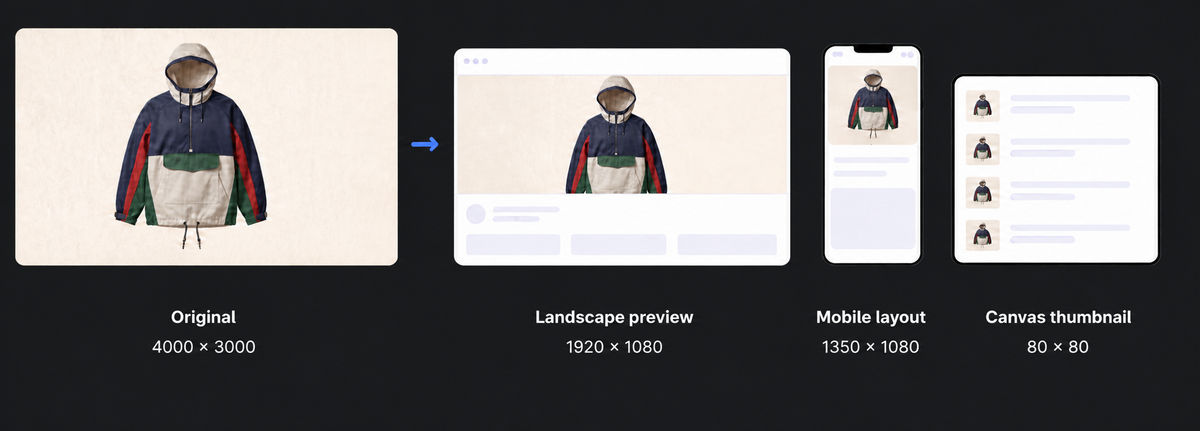
FLORA uses ImageKit's URL-based transformations to request the version of an asset required by each part of the application.
A single source image can be resized or cropped for a canvas thumbnail, a larger preview, or another display layout without FLORA pre-generating and storing each variation. ImageKit can similarly resize videos and extract images from specific video frames for thumbnails.
Generated transformations and source assets are cached through ImageKit's delivery infrastructure, removing the need for FLORA to build its own transformation and caching layer.
2. One consistent media pipeline across sources and storage providers
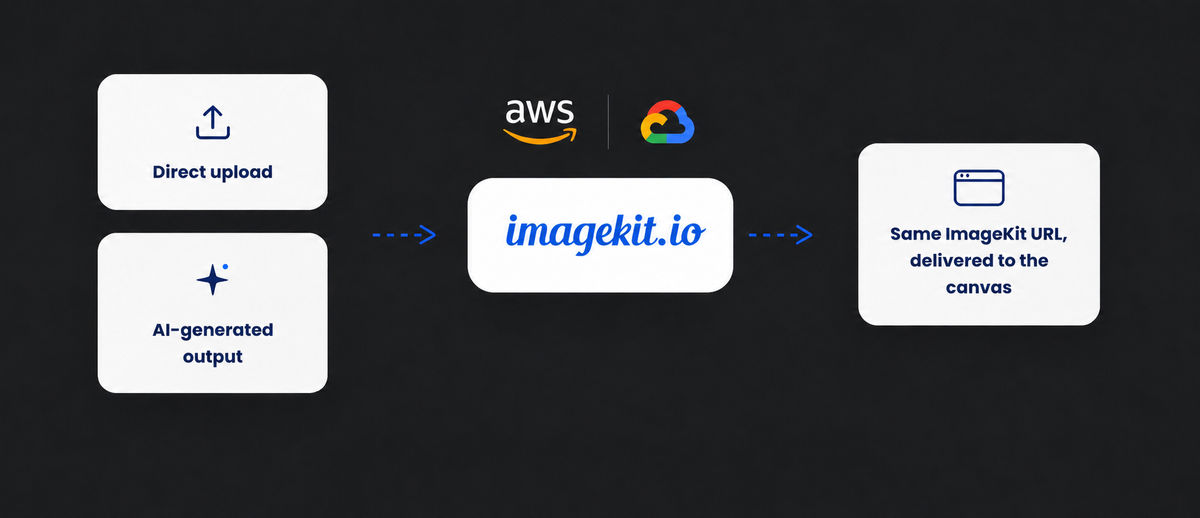
Media enters FLORA through direct user uploads and AI-generated outputs. Once an asset is stored in a cloud storage system connected to ImageKit, FLORA makes it available in the browser through an ImageKit URL.
ImageKit supports a wide range of cloud storage providers and external origins, giving FLORA a consistent layer for fetching, transforming, optimizing, and delivering media that works with its infrastructure.
This allows FLORA to use the same URLs, transformations, and delivery workflow regardless of how an asset was created or where it is stored. The underlying storage can evolve without requiring FLORA to redesign the media layer used throughout its application.
3. Automatic optimization for images and videos
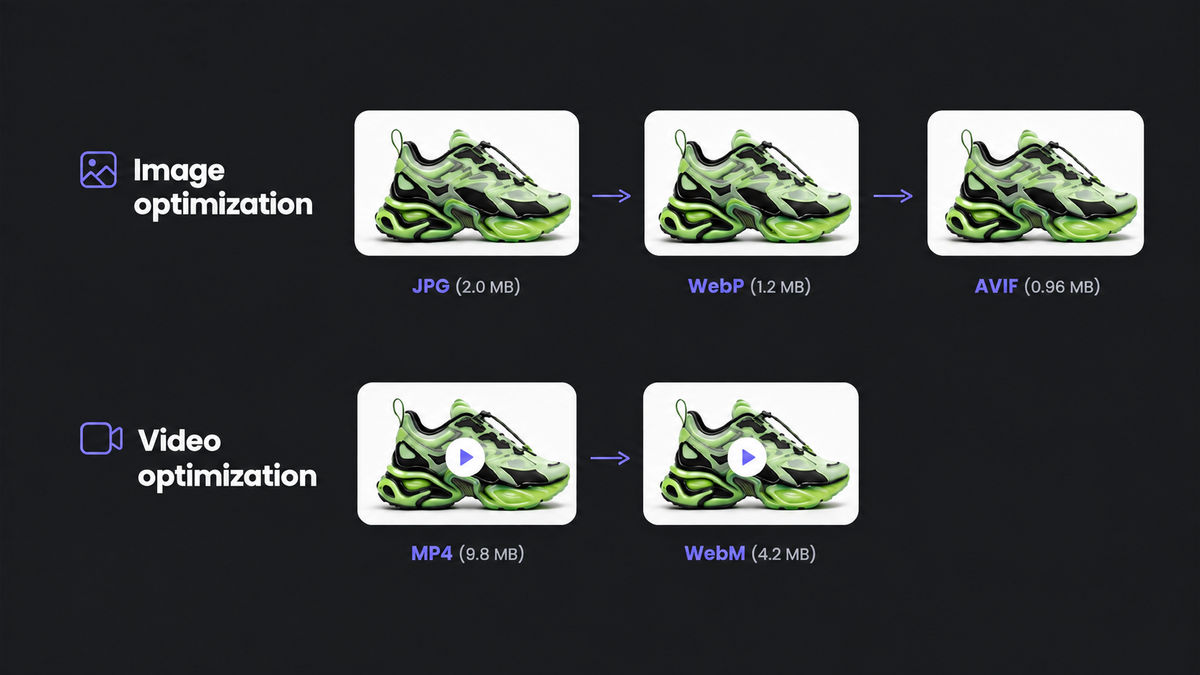
ImageKit automatically optimizes images and videos for web delivery based on factors such as the source asset, browser capabilities, and account settings, using the same media URL-based API.
Supported browsers can receive more efficient image or video formats, while other clients receive compatible alternatives. ImageKit can also adjust quality and dimensions to reduce unnecessary payload size. The original stored asset remains available when FLORA needs it.
This allows FLORA to reduce data transfer without maintaining its own intelligent format conversion and encoding infrastructure.
4. Support for high-resolution creative work
FLORA's most advanced users are often the first to encounter file-size, resolution, and processing limits.
FLORA and ImageKit have worked together to raise relevant processing limits as these requirements have evolved. This is particularly important because the users pushing those boundaries are often FLORA's most engaged professional customers.
5. Digital asset management for non-technical teams
ImageKit also supports use cases outside FLORA's core application.
FLORA's non-technical teams use ImageKit DAM to upload and manage internal media. This gives those teams a straightforward way to manage assets without working directly with a complex cloud storage or relying on engineering support.
.png?tr=w-1200%2Cc-at_max)
The Results: Supporting 20x traffic growth without rebuilding the media pipeline
As FLORA's user base and product usage expanded, the volume of traffic delivered through ImageKit grew by approximately 20x between June 2025 and June 2026.
The increase was driven by FLORA's growth: more subscribers were using the platform, existing users were generating more media per session, and video was becoming a larger part of creative workflows.
ImageKit supported this increase without requiring FLORA to replace or fundamentally redesign its media-delivery architecture. The same pipeline continued to handle transformations, thumbnails, optimization, caching, and delivery across user-uploaded and AI-generated media.
"ImageKit's team has been responsive, and we're happy with the partnership so far."
Alex Li, Co-founder at FLORA
What's next
FLORA continues to add new models, workflows, and creative capabilities to its canvas. Its media pipeline has kept pace through significant traffic growth and changes in media storage and processing requirements.
As FLORA's power users work with increasingly large and high-resolution assets and as model capabilities evolve, FLORA and ImageKit will continue collaborating on the processing and delivery requirements needed to support them.
This leaves FLORA's engineering team free to focus on what differentiates the company: the creative canvas and the workflows built on top of it, while ImageKit manages the image and video infrastructure underneath.