Customer Snapshot
- Industry: Agritech
- Scale: 7M+ downloads of the Kisan Agridoctor mobile app, ~75K monthly visitors on the web
- Business model: Omnichannel agritech serving farmers directly and retail partners through B2B channels
- Primary users: Farmers using Android smartphones across rural and semi-rural India, often on constrained networks and lower-end devices
Key results at a glance
About AgroStar
AgroStar is an omnichannel agritech company, helping farmers access agricultural inputs, advisory services, and commerce through a digital-first ecosystem.
Its flagship Kisan Agridoctor app enables farmers to diagnose crop issues, browse products, and place orders for seeds, fertilizers, pesticides, and farm hardware. AgroStar also operates the Saathi app, which supports retail-partner ordering across its B2B network. AgroStar also operates internal web-based platforms that support order placement, fulfillment, and operations across its farmer-facing and retail-partner channels.
Visual content is central to AgroStar's digital experience. Campaign images drive engagement for offers and promotions. Product images help farmers and retail partners evaluate items before purchase. Farmers upload crop photos so AgroStar's team can identify issues and recommend solutions. Educational videos help farmers learn preventive measures and best practices for improving crop yield.
As these visual experiences scaled, AgroStar needed a more efficient way to deliver high-performance media experiences across apps, web, devices, storage systems, and network conditions.
The Challenge: Delivering rich media to farmers on constrained networks and low-end devices
Before ImageKit, AgroStar served images directly from a public AWS S3 bucket. This worked in the early stages, but as the company's user base grew, its content team began creating higher-resolution campaign and product assets, and as the company began using multiple cloud providers, direct media delivery became harder to scale efficiently.
For AgroStar, media performance was not just an infrastructure concern. Many users are farmers in rural and semi-rural India, where mobile connectivity can be inconsistent, bandwidth may be limited, and users often rely on prepaid data plans. In this environment, every extra kilobyte can affect page load speed, data consumption, and the ability of farmers to browse products, view advisory content, or upload crop images.
Device capability added another constraint. A significant share of farmers access AgroStar on lower-end Android smartphones with limited processing power, memory, and storage. Heavy, full-resolution media can make app experiences feel slower and less responsive, especially when combined with unstable or low-bandwidth networks.
1. Heavy images leading to poor performance across devices
AgroStar's content team typically created campaign and product assets in high resolution and JPEG format. Since images were delivered directly from S3, every device received the same file, regardless of network quality, display size, or device capability.
This issue was exacerbated by the fact that a thumbnail, a product card, and a full-width campaign banner could all fetch the original source image.
The marketing team also frequently used animated GIFs for offers and campaign banners. These GIF files were often large, creating another hidden source of bandwidth consumption across the app and website.
All of these issues created avoidable overhead due to large files that were never displayed at their original dimensions.
2. Manual watermarking efforts were slowing things down
For certain use cases, farmers upload crop photos through the app so AgroStar's experts can diagnose issues and provide guidance. Watermarking these images required manual intervention, slowing down the workflow for taking user-generated content live.
3. Growing video requirements
AgroStar also produces educational video content to help farmers learn best practices and preventive measures for better crop yields. As the team began using short video previews across product and advisory experiences, they needed a simple way to generate and deliver trimmed clips without building a separate video-processing pipeline.
Why AgroStar Chose ImageKit
AgroStar adopted ImageKit based on their CTO's prior experience with ImageKit. Having used it at a previous company, he knew it could serve as a reliable optimization and delivery layer on top of existing storage, and also provide strong, responsive support.
"There have been moments where we hit a wall and needed answers fast. The ImageKit support team worked through it with us directly. That kind of responsiveness is hard to find."
— Vasan Subramanian, Principal Engineer, AgroStar
The Solution: One Media Delivery Pipeline Across Multi-Cloud Storage, Images, GIFs, Video, and User Uploads
With ImageKit, AgroStar moved from direct S3 delivery to a unified media optimization and delivery pipeline that supports its existing multi-cloud storage architecture and handles image transformations, format optimization, GIF conversion, watermarking, and video previews from one layer.
1. Seamless integration with existing multi-cloud storage
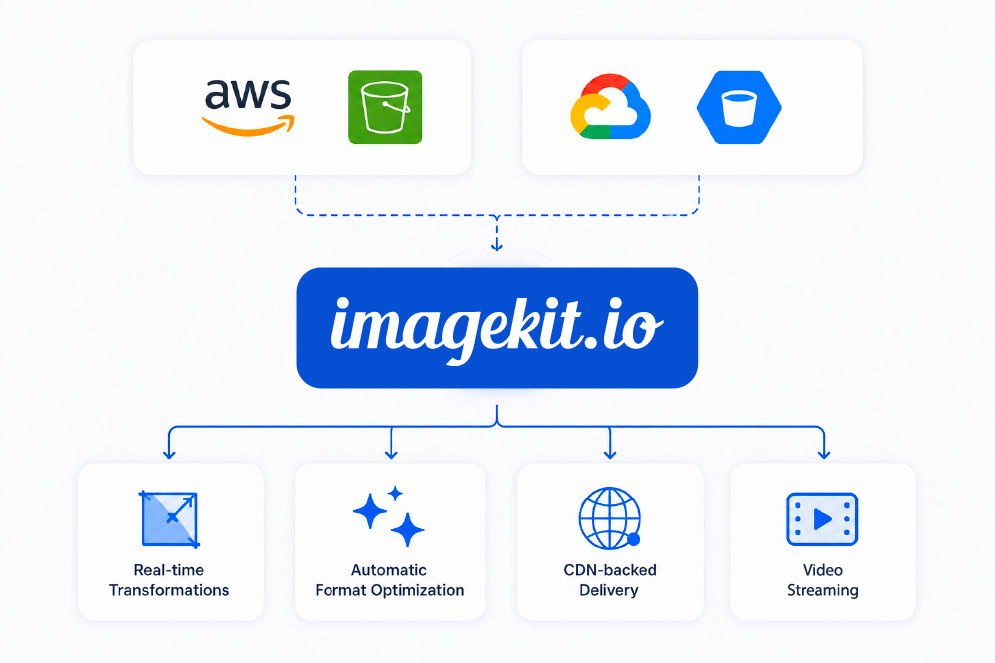
AgroStar stores images and videos in AWS S3, while user-generated content is stored in Google Cloud Storage. ImageKit connects to both as external origins using read-only credentials.
This allowed AgroStar to keep its multi-cloud storage architecture and buckets intact while adding real-time transformations, automatic format optimization, CDN-backed delivery, and video capabilities on top of the existing setup. ImageKit became the delivery and optimization layer across both cloud providers.
2. Automatic format optimization across Android and web
ImageKit automatically detects device and browser capabilities and delivers images in the most efficient supported format, such as WebP or AVIF, without requiring changes to the source asset.
For AgroStar's Android app, where native clients do not exhibit format support in the same way, the team explicitly forced the format to WebP using ImageKit's real-time conversion to supported Android devices.
This helped AgroStar reduce payload sizes while continuing to serve the same underlying assets from its existing storage systems.
3. Real-time resizing and smart cropping for every display size
Farmers upload crop photos from thousands of devices, each producing images at different resolutions and aspect ratios.
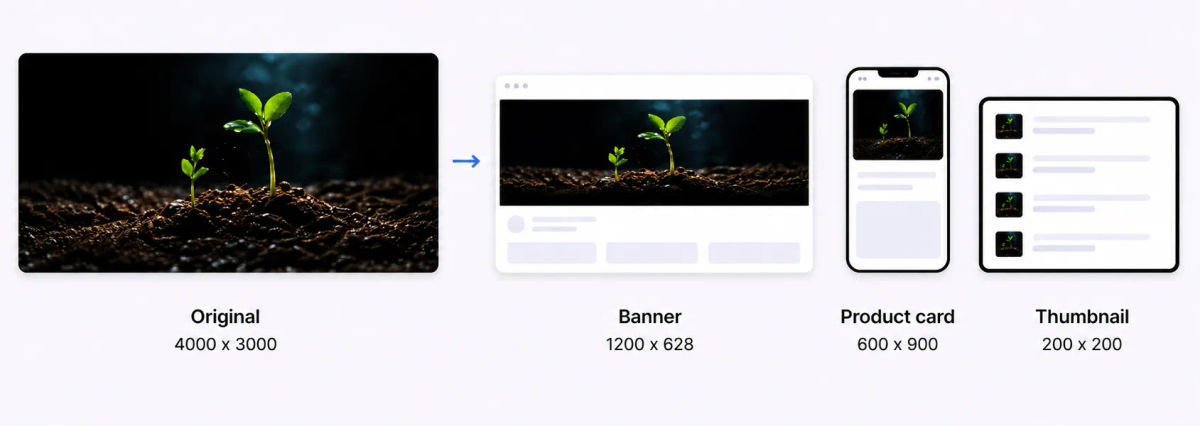
ImageKit's URL-based transformations allow AgroStar to resize images in real time and serve each asset at the exact dimensions required by the app or web layout. Its smart crop capability helps keep the most important part of an image in focus when it is cropped to a new aspect ratio. This is particularly useful for user-generated crop photos and campaign visuals that need to appear across multiple layouts.
Instead of delivering full-resolution originals everywhere, AgroStar can generate the right variant for each placement — thumbnails, product cards, banners, advisory images, and more.
4. Automated watermarking
AgroStar also applies watermarks to farmer-uploaded field photos using ImageKit's URL-based layer transformations, which allow adding multiple layers of text and images to a base image. This removed a manual step from the content workflow and made user-generated image delivery more consistent.
5. GIF-to-video conversion for campaign banners
Promotional GIFs were a recurring bandwidth challenge for AgroStar's marketing team. With ImageKit, AgroStar converts GIFs to video formats at delivery time using URL-based transformations. MP4 videos are significantly lighter, at times almost 1/10th the size, because of the way compression algorithms work in GIF and MP4 formats.
This reduces payload size without changing the creative workflow. The marketing team can continue producing animated campaign assets, while ImageKit handles more efficient delivery to end users.
6. URL-based real-time video previews
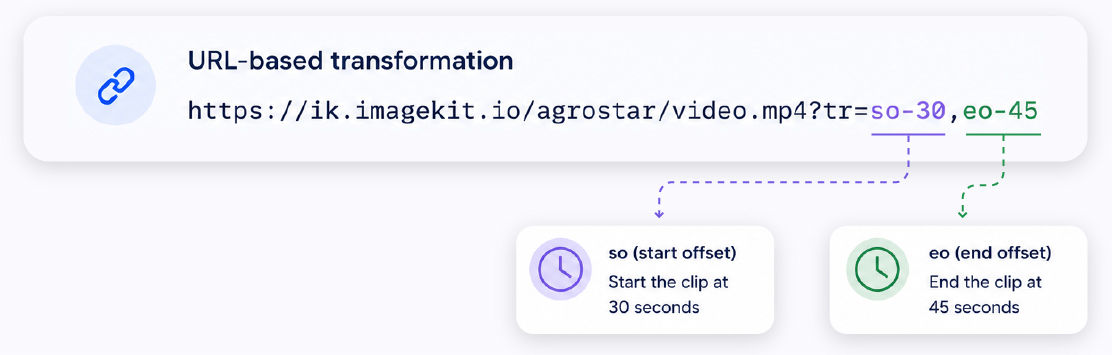
AgroStar's educational videos are generally hosted on YouTube, but certain app and web experiences require short preview clips. For these use cases, AgroStar replicates the original videos to S3 and uses ImageKit's Video transformation API to generate and deliver trimmed previews. Using URL parameters such as so for start offset, eo for end offset, and du for duration, the team can generate the exact clip needed at delivery time without maintaining a separate video-processing workflow or maintaining any internal processed video storage.
The Results: Existing Infrastructure Preserved, Media Delivery Optimized Across Every Surface
ImageKit has become AgroStar's centralized media optimization and delivery layer across app, web, marketing, user-generated content, and video-preview workflows.
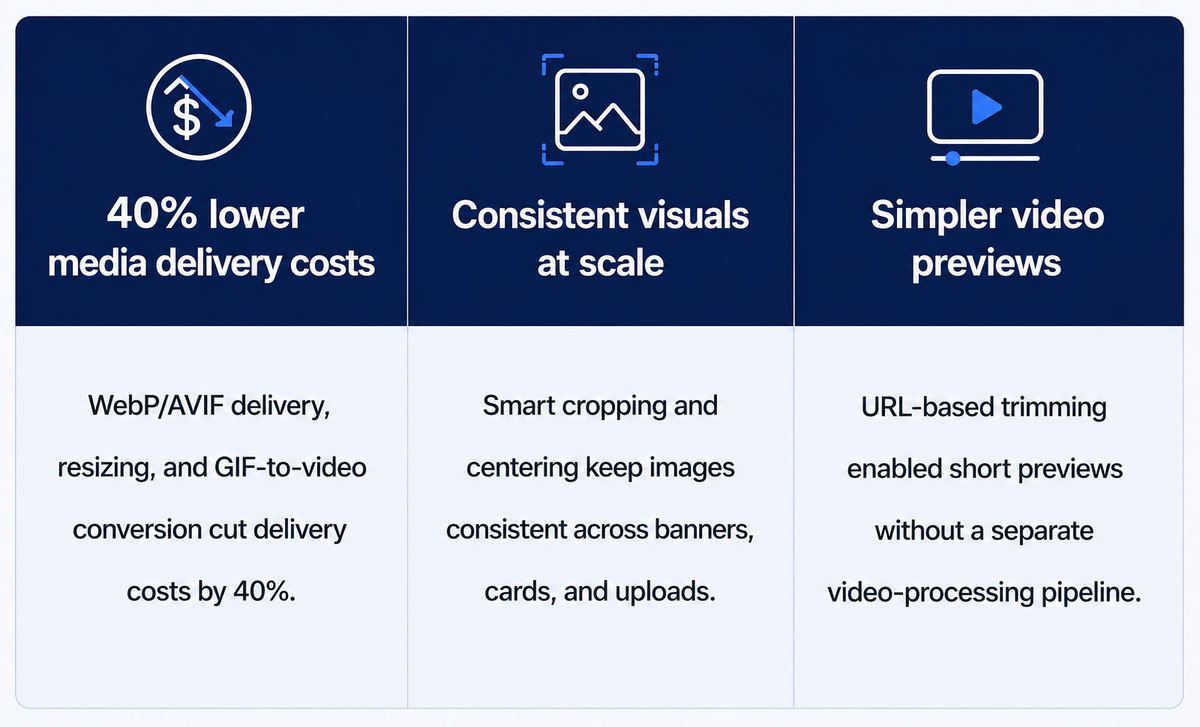
- 40% lower media delivery costs: WebP/AVIF delivery across devices, real-time resizing, and GIF to video conversion helped reduce bandwidth and delivery costs by 40%
- No migration required: ImageKit worked with AgroStar's existing multi-cloud storage setup, avoiding infrastructure changes.
- Consistent visuals at scale: Cropping and centering help the same assets work across banners, product cards, and uploaded crop images.
- Simpler video previews: URL-based trimming enabled short previews without a separate video-processing pipeline.
- Faster team execution: Engineering, product, and content teams now work through a single, consolidated media pipeline, improving time-to-live for new campaigns.
"We've been on ImageKit for six years, and the value has built up gradually. What started as an image delivery layer on top of our S3 buckets has become the single pipeline for everything we serve - format optimization, GIF conversions, video previews, and user-uploaded content. We've reduced our bandwidth costs by 40% through optimizations we've layered in over the years. Today we don't think about media infrastructure at all."
— Sunil Jain, CTO, AgroStar
What's Next
Six years in, ImageKit is the default media infrastructure behind AgroStar's digital experiences. The team plans to bring more applications and workflows under the same pipeline. With ImageKit handling media optimization and delivery across multi-cloud storage, AgroStar's teams can stay focused on building better digital experiences for farmers and retail partners without scaling a separate media infrastructure layer alongside the business.