Customer Snapshot
- Industry: Construction Management Software
- Scale: 15M image requests per month
- Business Model: B2B SaaS, mobile-first (90% of sessions; 56% Android, 33% iOS)
- Users: Field workers and site managers across native apps and web browsers
- On ImageKit since: 2021
Key results at a glance
About Remato
Remato describes itself as the operating system for a construction company. The platform helps construction businesses replace scattered WhatsApp threads, paper timesheets, phone calls, spreadsheets, and informal field updates with a single system of record for what happened on site. Remato's crew management product is most commonly used by construction firms with 10 to 100 employees, where field teams need a simple way to document work, communicate progress, and keep the office aligned with what is happening on site.
Images are central to that workflow. Field workers attach photos to time tracking entries to prove work was completed. Site teams add images to planning tasks to show what needs to be done. Equipment checks use photos to document whether tools are working, damaged, or missing. Those images later become part of internal reports, client updates, dispute documentation, and in some markets, daily government-required site diaries.
"The pain point we solve is something every construction company recognises: information between the office and the field still flows through consumer messaging apps, phone calls, paper, and face-to-face meetings. Site managers don't know if their crew is on-time, can't be confident progress is being made correctly, struggle to assemble client reports, and have nothing to fall back on in a dispute. Tools get lost because tracking lives in someone's outdated spreadsheet. We replace all of that with a single system designed for people who don't sit at a desk."
— Viljar Kärgenberg, CTO at Remato
As image documentation became a core part of Remato's customer experience, the team needed a media infrastructure layer that could scale with usage, support a wide range of devices, and reduce the engineering effort required to maintain image delivery in-house.
The challenge: Unoptimized delivery, a wide device range, and infrastructure hitting its limits
Before ImageKit, Remato ran its image workflow on a self-hosted setup. The platform stored roughly one thumbnail and one full-size JPEG per uploaded image and served those files as-is.
This approach worked in the early stages, but as customer usage increased and images became embedded across more workflows, Remato's image infrastructure started to create performance, scalability, and maintenance challenges.
A single field worker can upload 20 to 40 images in one session. Across thousands of users, this created a high-volume image delivery workload that needed to perform reliably across construction sites, offices, native apps, browsers, large screens, and specialized field devices.
1. Image delivery was not optimized for bandwidth or device capability
Remato's original setup had no dedicated transformation or optimization layer. Images were stored and served primarily as JPEGs, with no automatic format optimization, no responsive sizing strategy, and no compression workflow tailored to the requesting device.
That meant the platform could end up delivering heavier files than necessary, even when modern formats such as AVIF or WebP could provide a much more efficient experience.
For a mobile-first product used on construction sites, this mattered. Field teams often work in environments where connectivity can vary significantly, and heavy image payloads can slow down documentation, reporting, and review workflows.
2. The device landscape was too broad for pre-generated variants
Remato runs across native iOS, Android apps, and web browsers. Each device can require different image dimensions, layouts, pixel densities, and performance characteristics. Pre-generating image variants for every possible screen size and device type would have added significant complexity and still struggled to keep pace with new devices and UI changes.
The team needed a way to request the right image size at delivery time instead of maintaining a growing library of pre-generated versions.
3. In-house image infrastructure was creating engineering overhead
Thumbnail generation, image storage, serving logic, and delivery maintenance were all part of Remato's internal codebase. As the product scaled, this image stack became a growing operational burden. Every new layout, device type, or performance requirement had the potential to create additional engineering work.
For a lean product team, maintaining image infrastructure was not where they wanted to spend time. The engineering team needed to focus on the construction management workflows customers were paying for, not the media stack underneath them.
Why Remato Chose ImageKit
When Remato evaluated image delivery providers, the decision came down to three priorities: storage and transformations in one platform, real-time transformations, and predictable pricing at the scale they expected to reach.
ImageKit covered all three requirements.
By consolidating storage, optimization, transformation, and delivery into one service, ImageKit gave Remato a simpler operating model for image infrastructure. The team could avoid building and maintaining a more complex internal pipeline while still supporting the device diversity and high image volume of a mobile-first construction platform.
The Solution: A Unified Image Pipeline for Storage, Transformation, Optimization, and Delivery
ImageKit now handles storage, real-time transformations, automatic format optimization, CDN delivery, and upload handling across Remato's product surfaces.
1. Real-time transformations for every device and layout
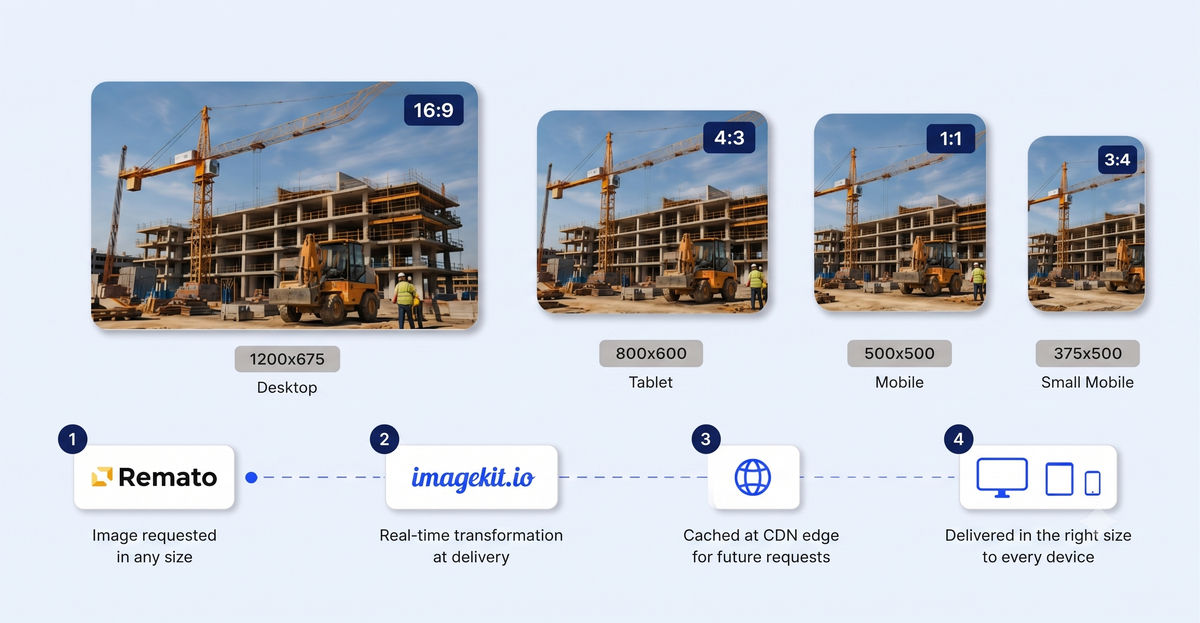
Instead of pre-generating variants for every device, screen size, and pixel density, Remato uses ImageKit's URL-based transformations to request images in the required size at delivery time.
When an image variant is requested for the first time, ImageKit generates the transformation in real time. The transformed asset is then cached at the CDN edge for future requests.
This gives Remato the flexibility to support native apps and web browsers without maintaining a separate image generation workflow for each surface. Supporting a new layout or device type no longer requires additional image infrastructure work.
2. Automatic format optimization with AVIF and WebP
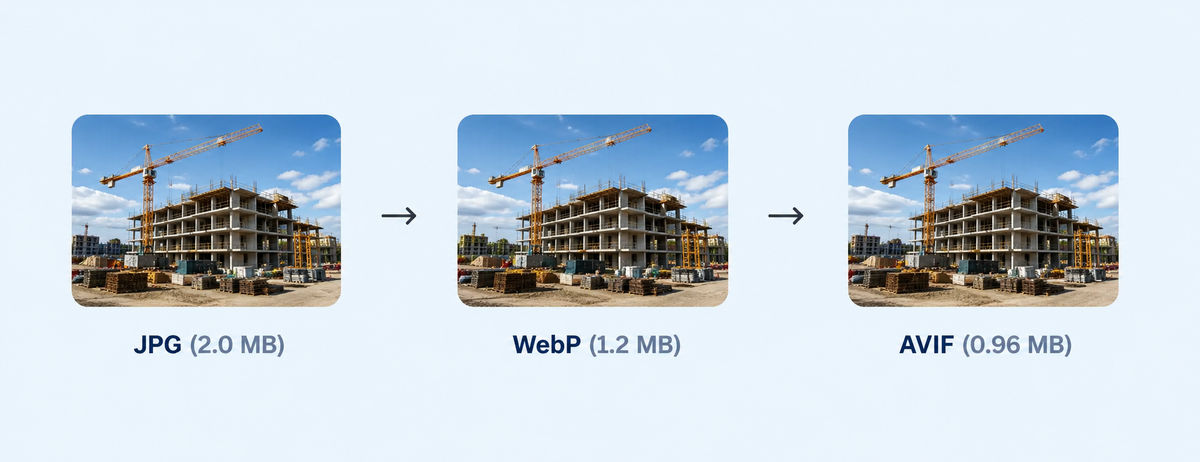
ImageKit detects what each client can support and delivers modern formats such as AVIF or WebP wherever possible.
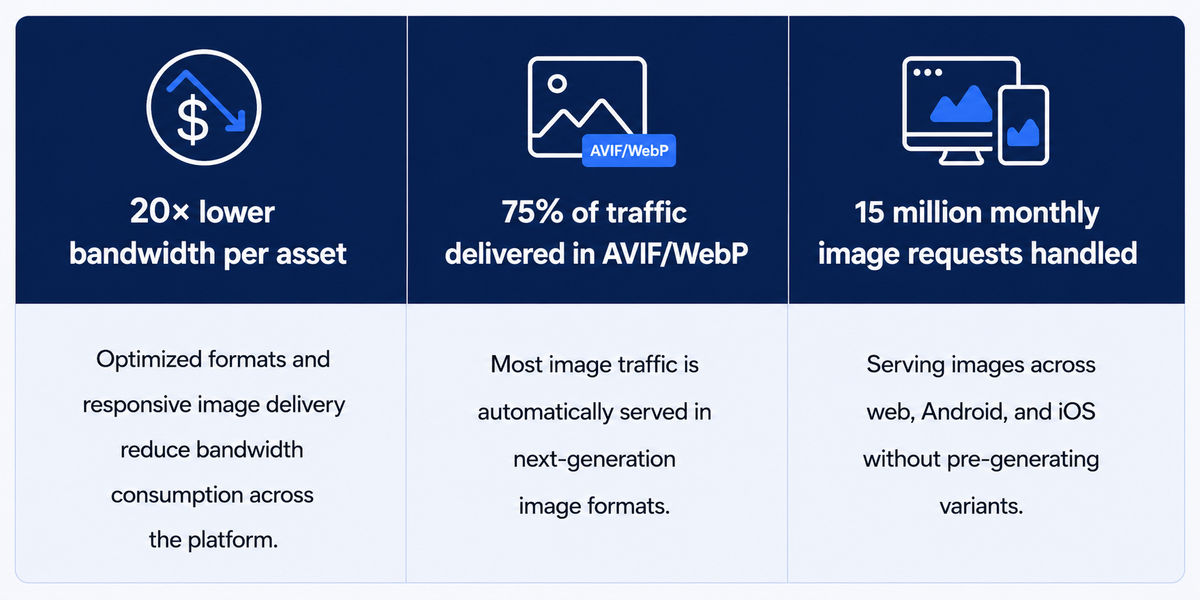
Today, about 75% of Remato's image traffic is delivered in AVIF or WebP. According to Remato's estimate, serving the same volume as full-resolution JPEGs would require at least 20 times more bandwidth per asset.
Original files are still available when needed, but Remato only serves them for explicit export requests. For day-to-day product usage, ImageKit delivers optimized formats automatically.
3. A simple, stable upload pipeline through ImageKit's SDK
Remato handles image uploads through ImageKit's server-side SDK. Each upload returns the CDN URL and EXIF metadata, including image dimensions, which Remato stores in its own database.
The integration is lightweight, running in approximately 100 lines of server-side code. This gave Remato a clean upload workflow without building and maintaining its own storage, metadata extraction, and delivery pipeline. Remato has gone through major ImageKit SDK updates without breaking refactors or operational incidents tied to image delivery.
The result is infrastructure that behaves like infrastructure should: stable, predictable, and largely invisible to the product team.
The Results: Lighter delivery, low maintenance
With just 100 lines of server-side code, Remato handles all its image processing and delivery requirements with ImageKit.
- 15 million monthly image requests handled at scale: ImageKit now powers Remato's image delivery across 12,000 monthly active users and a mobile-first product experience spanning native Android, iOS apps, and web browsers without pre-generating variants.
- 75% of image traffic delivered in AVIF or WebP: Automatic format optimization helps reduce bandwidth across image-heavy workflows like time tracking, site documentation, planning, tools management, and reporting.
- Approximately 20x lower bandwidth per asset: Optimized formats and right-sized delivery allow Remato to scale image usage without a proportional increase in bandwidth consumption.
- Minimal engineering overhead: In four and a half years, ImageKit has run reliably in the background without pulling engineers into image infrastructure issues. This allows the team to spend less time on maintenance and more time building construction management workflows, with the rare issues that arise handled seamlessly without disrupting development.
"ImageKit handles the heavy lifting on image delivery, so our team doesn't have to. The SDK is straightforward to integrate, transformations work exactly as expected across every device we support, and in four and a half years, we haven't had a single incident that needed our attention. That's exactly what infrastructure should feel like."
— Viljar Kärgenberg, Head of Technology at Remato
What's next
The bet Remato made four and a half years ago was on consolidation: one provider for storage, transformations, and delivery, priced predictably at the volume they were forecasting. That bet has held. Image volume in a month now overtakes what used to take a full year, the device footprint has widened, and the format landscape has shifted from JPEG by default to AVIF and WebP. Remato's engineering team now spends its time on the product its customers actually pay for, not on the image stack underneath it.
Construction documentation is moving toward video, and Remato is moving with it. ImageKit's Adaptive Bitrate Streaming (ABS) fits that direction well. Mobile signal changes between job sites, and ABS adjusts video quality to match available bandwidth in real time. Remato is also evaluating ImageKit's overlay capabilities for watermarking on client-facing exports.